Model Gallery

Discover and install AI models from our curated collection

306 models available
1 repositories
Documentation

Find Your Perfect Model

Filter by Model Type

Browse by Tags

qwen3.8-flash-next-coder-iq1_m
Qwen3.8-Flash-Next, a 125B-parameter hybrid mixture-of-experts model, in ISTA-DASLab's Coder release (IQ1_M): half of the experts (256 of 512 per layer) are kept, chosen on code, agent and image data, so it is smaller and faster but weaker outside code and in languages other than English (Chinese and other CJK text included) (about 59 GB to download). It reads images through the vision projector published for the original model, and the Strata backend parses its reasoning and tool calls. Needs about 32 GB of RAM (23 GB of experts in RAM) with a suitable GPU, and fast SSD storage: the 29 GB n-gram table stays on disk. Needs a GPU the strata backend supports; NVIDIA with 12 GB of VRAM or more is the class Strata tests. Runs only on the experimental strata backend. On the first load the strata backend builds the Strata pack from the GGUF files (a few minutes, a few GB of extra disk); a finished pack is never rebuilt. The experts are read from the GGUF files in place (mapped); add --resident-experts to engine_args to copy them into RAM when there is room. Licensed under the Qwen Community License 1.0 (inherited from Qwen/Qwen3.8-Flash-Next): free use, but a Model as a Service or AI Work Assistant business needs a licence from Qwen. Read the LICENSE file in the repository first. The GGUF files are the Coder GSQ-RCO quantization by ISTA-DASLab; Strata is by Niko1221. The MTP draft layer is not configured here.

Repository: localaiLicense: qwen-community-1.0

qwen3.8-flash-next-gyro-s
Qwen3.8-Flash-Next, a 125B-parameter hybrid mixture-of-experts model, in agentionai's Gyro-S quantization (trellis-coded experts), the smallest option, for machines with little memory and lower in quality (about 59 GB to download). It reads images through the vision projector published for the original model, and the Strata backend parses its reasoning and tool calls. Needs about 28 GB of VRAM and RAM together for the weights. Half of the file is the n-gram table, which stays on disk and is read for every token, so keep it on a fast local SSD. Needs a GPU the strata backend supports; NVIDIA with 12 GB of VRAM or more is the class Strata tests. Runs only on the experimental strata backend. On the first load the strata backend builds the Strata pack from the GGUF files (a few minutes, a few GB of extra disk); a finished pack is never rebuilt. The experts are read from the GGUF files in place (mapped); add --resident-experts to engine_args to copy them into RAM when there is room. Licensed under the Qwen Community License 1.0 (inherited from Qwen/Qwen3.8-Flash-Next): free use, but a Model as a Service or AI Work Assistant business needs a licence from Qwen. Read the LICENSE file in the repository first. The GGUF file is the Gyro quantization by agentionai; the vision projector is ISTA-DASLab's file for the original model; Strata is by Niko1221. The MTP draft layer is not configured here.

Repository: localaiLicense: qwen-community-1.0

qwen3.8-flash-next-gyro-m
Qwen3.8-Flash-Next, a 125B-parameter hybrid mixture-of-experts model, in agentionai's Gyro-M quantization (trellis-coded experts), about IQ3_XXS quality with about 20% less GPU memory, 16 to 21% slower than Q2_0 (about 93 GB to download). It reads images through the vision projector published for the original model, and the Strata backend parses its reasoning and tool calls. Needs about 35 GB of VRAM and RAM together for the weights. Half of the file is the n-gram table, which stays on disk and is read for every token, so keep it on a fast local SSD. Needs a GPU the strata backend supports; NVIDIA with 12 GB of VRAM or more is the class Strata tests. Runs only on the experimental strata backend. On the first load the strata backend builds the Strata pack from the GGUF files (a few minutes, a few GB of extra disk); a finished pack is never rebuilt. The experts are read from the GGUF files in place (mapped); add --resident-experts to engine_args to copy them into RAM when there is room. Licensed under the Qwen Community License 1.0 (inherited from Qwen/Qwen3.8-Flash-Next): free use, but a Model as a Service or AI Work Assistant business needs a licence from Qwen. Read the LICENSE file in the repository first. The GGUF file is the Gyro quantization by agentionai; the vision projector is ISTA-DASLab's file for the original model; Strata is by Niko1221. The MTP draft layer is not configured here.

Repository: localaiLicense: qwen-community-1.0

deepseek-v4.1-flash-ista-iq2_xxs
DeepSeek-V4.1-Flash-1017, a 763B-parameter mixture-of-experts model (384 experts per layer, 6 used per token), in ISTA-DAS's 2.00 bits per weight GSQ-RCO quantization (IQ2_XXS), the middle size of the three (about 257 GB to download). It writes a reasoning trace before the answer, and the Strata backend splits it from the reply and parses the model's DSML tool calls. Text only: images are not supported by this backend. Needs a GPU with 12 GB of VRAM or more and about 40 GB of RAM at the least (Strata's figure; its measurements use 46 to 64 GB: an RTX 5070 with 64 GB answered at about 5 tokens per second, an RTX 3060 with 46 GB at 8 to 10). Less RAM still runs, slowly. Strata measured a perplexity 15.5% above the original model on 4,995 positions (code 8.6%, agent work 5.3%). Needs about 258 GB of free disk, on a fast NVMe drive: the 111 GB n-gram table (Engram) stays on disk and is read for every token. The Engram table and the 8 GB DSpark draft model are shared by all DeepSeek-V4.1 entries and downloaded once into strata/models/deepseek-v4.1-flash-shared. Runs only on the experimental strata backend, on NVIDIA CUDA 13 (x86_64 and arm64), AMD Radeon RX 9070 and R9700 (ROCm) and Apple Silicon (Metal). Strata ships no DeepSeek engine for CUDA 12, Intel or other AMD cards. On the first load the strata backend builds the Strata pack from the GGUF files (under a minute, a few MB of extra disk); loading the model afterwards takes a few minutes. The default context is 8192 tokens, the size Strata checked; raise context_size if the GPU has room. Licensed under the MIT License (DeepSeek-V4.1-Flash-1017 and the quantized files). The GGUF files are the GSQ-RCO quantization by ISTA-DAS (ISTA-DASLab); the DSpark draft model is Unsloth's; Strata is by Niko1221.

Repository: localaiLicense: mit

deepseek-v4.1-flash-ista-iq2_xs
DeepSeek-V4.1-Flash-1017, a 763B-parameter mixture-of-experts model (384 experts per layer, 6 used per token), in ISTA-DAS's 2.25 bits per weight GSQ-RCO quantization (IQ2_XS), the largest size of the three (about 274 GB to download). It writes a reasoning trace before the answer, and the Strata backend splits it from the reply and parses the model's DSML tool calls. Text only: images are not supported by this backend. Needs a GPU with 12 GB of VRAM or more and about 44 GB of RAM at the least (Strata's figure; its measurements use 46 to 64 GB: an RTX 5070 with 64 GB answered at about 5 tokens per second, an RTX 3060 with 46 GB at 8 to 10). Less RAM still runs, slowly. Strata measured a perplexity 7.3% above the original model on 4,995 positions (code 3.2%, agent work 2.2%). Needs about 275 GB of free disk, on a fast NVMe drive: the 111 GB n-gram table (Engram) stays on disk and is read for every token. The Engram table and the 8 GB DSpark draft model are shared by all DeepSeek-V4.1 entries and downloaded once into strata/models/deepseek-v4.1-flash-shared. Runs only on the experimental strata backend, on NVIDIA CUDA 13 (x86_64 and arm64), AMD Radeon RX 9070 and R9700 (ROCm) and Apple Silicon (Metal). Strata ships no DeepSeek engine for CUDA 12, Intel or other AMD cards. On the first load the strata backend builds the Strata pack from the GGUF files (under a minute, a few MB of extra disk); loading the model afterwards takes a few minutes. The default context is 8192 tokens, the size Strata checked; raise context_size if the GPU has room. Licensed under the MIT License (DeepSeek-V4.1-Flash-1017 and the quantized files). The GGUF files are the GSQ-RCO quantization by ISTA-DAS (ISTA-DASLab); the DSpark draft model is Unsloth's; Strata is by Niko1221.

Repository: localaiLicense: mit

deepseek-v4.1-flash-ista-coder-iq2_xxs
ISTA-DAS's coding version of DeepSeek-V4.1-Flash-1017: in every layer 192 of the 384 routed experts are kept and the other 192 removed, stored in the 2.00 bpw (IQ2_XXS) layout. It is the smallest DeepSeek-V4.1 set here (about 191 GB to download). It writes a reasoning trace before the answer, and the Strata backend splits it from the reply and parses the model's DSML tool calls. Text only: images are not supported by this backend. Needs a GPU with 12 GB of VRAM or more and about 24 GB of RAM at the least (Strata's figure; its measurements use 46 to 64 GB: an RTX 5070 with 64 GB answered at about 5 tokens per second, an RTX 3060 with 46 GB at 8 to 10). Less RAM still runs, slowly. Strata measured a perplexity 48% above the original model on its test set (KL 0.40), so it is weaker than the full sets on prose and general knowledge; it is meant for code and agent work. Needs about 192 GB of free disk, on a fast NVMe drive: the 111 GB n-gram table (Engram) stays on disk and is read for every token. The Engram table and the 8 GB DSpark draft model are shared by all DeepSeek-V4.1 entries and downloaded once into strata/models/deepseek-v4.1-flash-shared. Runs only on the experimental strata backend, on NVIDIA CUDA 13 (x86_64 and arm64), AMD Radeon RX 9070 and R9700 (ROCm) and Apple Silicon (Metal). Strata ships no DeepSeek engine for CUDA 12, Intel or other AMD cards. On the first load the strata backend builds the Strata pack from the GGUF files (under a minute, a few MB of extra disk); loading the model afterwards takes a few minutes. The default context is 8192 tokens, the size Strata checked; raise context_size if the GPU has room. Licensed under the MIT License (DeepSeek-V4.1-Flash-1017 and the quantized files). The GGUF files are the GSQ-RCO quantization by ISTA-DAS (ISTA-DASLab); the DSpark draft model is Unsloth's; Strata is by Niko1221.

Repository: localaiLicense: mit

deepseek-v4.1-flash-1017
# DeepSeek-V4.1-Flash-1017 Technical Report 👁️ ## Introduction **DeepSeek-V4.1-Flash-1017** is a minor update to **DeepSeek-V4.1-Flash**, delivering substantial improvements across reasoning, coding, agentic tasks, and visual benchmarks. Alongside these gains, the model reduces task execution time and output length, enabling users to complete tasks faster and at lower cost and advancing the performance–cost Pareto frontier across multiple agent harnesses. *† denotes the text-only subset of HLE. We use the Claude Code harness for Terminal-Bench 4.0 and the Mini-SWE-V2 harness for DeepSWE v1.1.* ## Prompt Encoding This release does not include a Jinja-format chat template. The `encoding` folder contains a self-contained Python reference implementation (`encoding.py`) with test cases for multi-turn conversations, tool calling, thinking mode, numeric reasoning effort, mid-conversation system messages, and interleaved image content. ...

Repository: localaiLicense: mit

qwen3.8-27b-imatrix-nvfp4-mtp
Qwen3.8-27B in cdiamond's iMatrix-calibrated mixed-precision NVFP4 build. Selected attention and feed-forward tensors retain higher precision. Includes the F16 vision projector and enables the embedded MTP draft head with one draft token per step.

Repository: localaiLicense: apache-2.0

spark-x2.5-4b
# Spark-X2.5 [](https://join.slack.com/t/tokenspark/shared_invite/zt-432qf8l2f-5~dLyXv8uETr0P0UuC07nw) [](https://discord.gg/kTDE2Hg8aw) [](https://www.youtube.com/@SparkLLM) [](https://dev.to/sparkllm) [](https://bsky.app/profile/sparkllm.bsky.social) [](https://x.com/sparkllm) [](https://www.zhihu.com/people/zhiikz7qh7m) [](images/xhtoken-wechat.jpg) > [!Note] > This repository contains model weights and configuration files for the post-trained model in the Hugging Face Transformers format. ## Introduction We are introducing Spark-X2.5-4B and Spark-X2.5-1.7B, two compact, general-purpose language models designed to make capable AI more practical, efficient, and accessible. The models deliver strong performance across a broad range of everyday tasks—including conversation, writing, translation, reasoning, coding, tool use, and agentic workflows—achieving leading results among open-source models of comparable size. Spark-X2.5 combines an efficiency-oriented architecture with native context windows of up to 1M tokens, and support for more than 200 languages. ...

Repository: localaiLicense: apache-2.0
deepseek-v4-flash-vision-exp
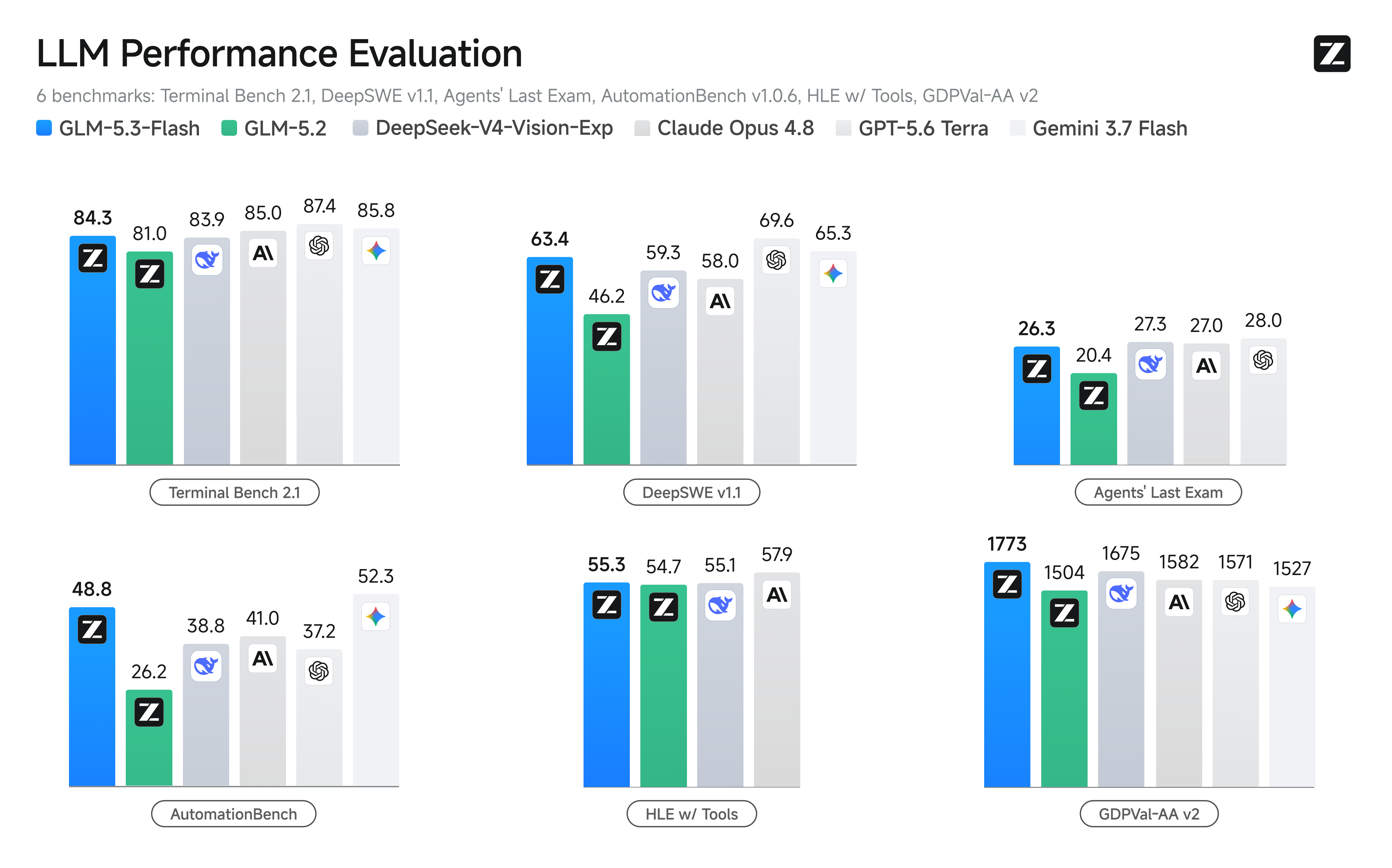
# DeepSeek-V4-Flash-Vision-Exp ## Introduction We are excited to introduce **DeepSeek-V4-Flash-Vision-Exp**, our first experimental multimodal model in the DeepSeek-V4 family. It builds on the DeepSeek-V4-Flash architecture by incorporating visual modules and undergoing continued training to unlock visual understanding capabilities. Compared to DeepSeek-V4-Flash-0731, DeepSeek-V4-Flash-Vision-Exp achieves substantial improvements on its multimodal agent capabilities, while maintaining comparable performance on text-only agent tasks. Notes: 1. For the text agent benchmarks above, DeepSeek models are evaluated with the minimal mode of DeepSeek Harness as the agent framework, using the `max` reasoning effort level with `temperature = 1.0, top_p = 0.95`. 2. † For ApexBench and Agents' Last Exam, DeepSeek-V4-Flash-0731 ignores the multimodal elements in the input. ## Repository layout This repository contains the tokenizer, prompt encoding reference, and a minimal PyTorch inference implementation for DeepSeek-V4 Flash Vision. The reference inference covers the vision encoder and aligner, DFlash attention, MoE, Hyper-Connections, and the DSpark forward path. ...

Repository: localaiLicense: mit

qwopus3.8-27b-flash-v2
Qwopus3.8-27B-Flash-V2 is a new post-training release for reasoning and agent workloads. This Q4_K_M GGUF includes the F32 vision projector and uses llama.cpp's embedded chat template with MTP speculative decoding.

Repository: localaiLicense: apache-2.0

qwopus3.8-27b-flash-v2-q8
Qwopus3.8-27B-Flash-V2 is a new post-training release for reasoning and agent workloads. This Q8_0 GGUF includes the F32 vision projector and uses llama.cpp's embedded chat template with MTP speculative decoding.

Repository: localaiLicense: apache-2.0

qwopus3.8-27b-flash
Qwopus3.8-27B-Flash is a Qwen3.8-27B fine-tune for reasoning and agent workloads. This Q4_K_M GGUF includes the F32 vision projector and uses llama.cpp's embedded chat template with MTP speculative decoding. The publisher reports a known Python code indentation issue.

Repository: localaiLicense: apache-2.0

qwopus3.8-27b-flash-q8
Qwopus3.8-27B-Flash is a Qwen3.8-27B fine-tune for reasoning and agent workloads. This Q8_0 GGUF includes the F32 vision projector and uses llama.cpp's embedded chat template with MTP speculative decoding. The publisher reports a known Python code indentation issue.

Repository: localaiLicense: apache-2.0

mimo-v2.6-distill-qwen-9b
MiMo-V2.6-Distill-Qwen-9B is Xiaomi MiMo's 9B Qwen3.5 fine-tune for coding, agent tasks, and visual coding. This Q4_K_M GGUF build uses llama.cpp with the model's embedded chat template and includes the F16 vision projector.

Repository: localaiLicense: mit

mimo-v2.6-distill-qwen-9b-q8
MiMo-V2.6-Distill-Qwen-9B is Xiaomi MiMo's 9B Qwen3.5 fine-tune for coding, agent tasks, and visual coding. This Q8_0 GGUF build uses llama.cpp with the model's embedded chat template and includes the F16 vision projector.

Repository: localaiLicense: mit

qwen3.8-27b-fable-5-coding-distilled
A 27B Qwen3.8 fine-tune for coding, debugging, and agentic reasoning. This Q4_K_M GGUF build uses llama.cpp, the embedded chat template, and the F16 vision projector.

Repository: localaiLicense: apache-2.0

qwen3.8-27b-fable-5-coding-distilled-q8
A 27B Qwen3.8 fine-tune for coding, debugging, and agentic reasoning. This Q8_0 GGUF build uses llama.cpp, the embedded chat template, and the F16 vision projector.

Repository: localaiLicense: apache-2.0

glm-5.3-flash
# GLM-5.3-Flash 👋 Join our WeChat or Discord community. 📖 Check out the GLM-5.3-Flash blog and GLM-5 Technical report. 📍 Use GLM-5.3-Flash API services on Z.ai API Platform. ## Introduction We introduce GLM-5.3-Flash, the first natively multimodal model in the GLM-5 series. With 320B total parameters and just 18B active parameters, it outperforms GLM-5.2 across benchmarks and real-world workloads at one-tenth the price, while approaching Claude Opus 4.8 on coding and agentic benchmarks. GLM-5.3-Flash starts from a newly trained base model, with its architecture and training recipe redesigned around capability and efficiency. For the first time in the GLM series, we introduce a hybrid architecture combining sparse and linear attention, sharply reducing long-context serving costs while preserving precise long-context capabilities. The model also adopts Manifold-Constrained Hyper-Connections (mHC) to further improve scaling efficiency. Together with our latest 30T-token multimodal pre-training corpus, these changes enable GLM-5.3-Flash to deliver more intelligence with less compute. ## Serve GLM-5.3-Flash Locally ...

Repository: localaiLicense: mit

apodex-1.1-mini-q4
Apodex-1.1-mini is an Apache-2.0 Qwen3.5 mixture-of-experts model for long-horizon research, data analysis, coding, file work, and tool use. It activates about 3B of its 35.95B parameters per token and supports text and image input with a context window of 262K tokens. This default entry uses the recommended Q4_K_M GGUF and F16 vision projector. An MTP-enabled build and a higher-quality Q8_0 model are available as variants.

Repository: localaiLicense: apache-2.0

apodex-1.1-mini-q4-mtp
Apodex-1.1-mini with MTP speculative decoding enabled on the recommended Q4_K_M GGUF. The model carries its native MTP head, so it needs no separate draft model. The F16 vision projector supports multimodal prompts.

Repository: localaiLicense: apache-2.0

Page 1 of many